

RISING TIDES
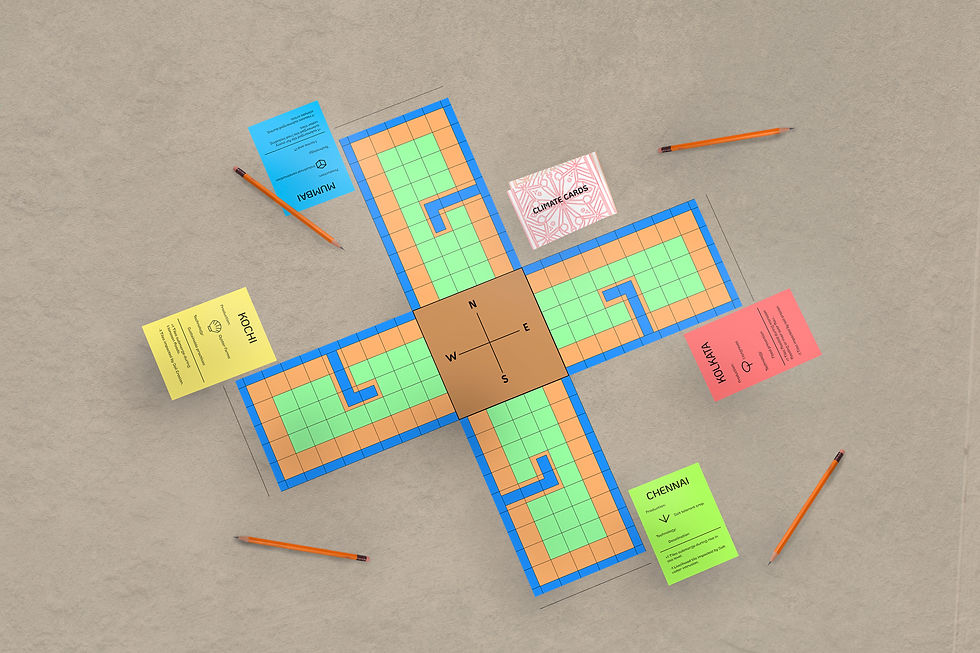
City-building board game in which players must guide coastal Indian cities against climatic challenges.
PREMISE
For a rapid prototyping project in my 6th semester in Srishti ,I was drawn to the growing threat of rising sea levels and their impact on India’s coastal cities.
After studying reports on climate change and witnessing how cities like Mumbai, Chennai, Kochi, and Kolkata are increasingly vulnerable to floods, cyclones, and erosion, I wanted to explore how communities can respond—not with fear, but with resilience and collaboration.
This led to Rising Tides, a cooperative board game where players become city leaders facing real-world climate challenges. Through strategic resource management, trading, and collective decision-making, players build defenses and adapt to a changing environment.
The game is both a reflection on the urgency of climate action and a tool to imagine how cooperation and sustainable planning can help safeguard our future.
Research
For Rising Tides, I explored how climate change—particularly rising sea levels—affects coastal cities in India. To create a meaningful and strategic gameplay experience, I researched several interconnected themes around climate adaptation and regional vulnerabilities, and integrated them into the game as summarized here:
Climate Data
Research into the effects of sea level rise (SLR) on Indian coastal cities informed the core mechanic—the SLR slider—which visually and mechanically tracks rising waters across the game.
As the slider advances, climate catastrophe cards (e.g., floods, cyclones) are triggered, directly mirroring real-world consequences of climate change.
City-Specific
Each city—Kolkata, Mumbai, Chennai, and Kochi—faces unique vulnerabilities drawn from research into their geography and infrastructure. These differences are reflected in City Profile Cards, which dictate city-specific strengths, challenges, and available resources, emphasizing the regional impact of climate change.
Choices
The game integrates environmental trade-offs by offering players a choice between sustainable technologies (like mangroves or oyster farms) and industrial solutions (like sea walls and desalination plants). Research into real-life sustainable practices informed how these options function in-game—sustainable choices offer long-term protection, while industrial options provide immediate but costly relief.
Co-operation
The game’s cooperative nature reflects the necessity of joint action in combating climate change. Mechanics such as trading, donations, and joint technology building reinforce the theme of shared responsibility and collective resilience.
Simulation
Drawing from educational research, Rising Tides is designed to simulate decision-making under environmental stress, helping players understand the exponential impact of inaction. The gradual increase in disaster intensity (mild to extreme climate cards) mirrors scientific models of accelerating climate risks, making the learning both interactive and impactful.
End Goal
The end goal of Rising Tides is twofold—survive escalating climate challenges and preserve livable spaces in your coastal city.
Manual
By keeping instructions clear and visual, players can learn without feeling overwhelmed. The cheat sheet at the back page make it easy for the players to quickly access the important things in the manual.
Manual
By keeping instructions clear and visual, players can learn without feeling overwhelmed. The cheat sheet at the back page make it easy for the players to quickly access the important things in the manual.
Documentation
This document showcases the game’s design journey, including the GDD, research, and iterations that shaped Rising Tides. It highlights key decisions and changes made throughout development to refine both gameplay and player experience.
Versions of the Board


